Five Non-Negotiable Site Benchmarks
Engineered for honey bee productivity, operator safety, and complete property tax audit defense.
1. Bear & Predator Electric Barrier
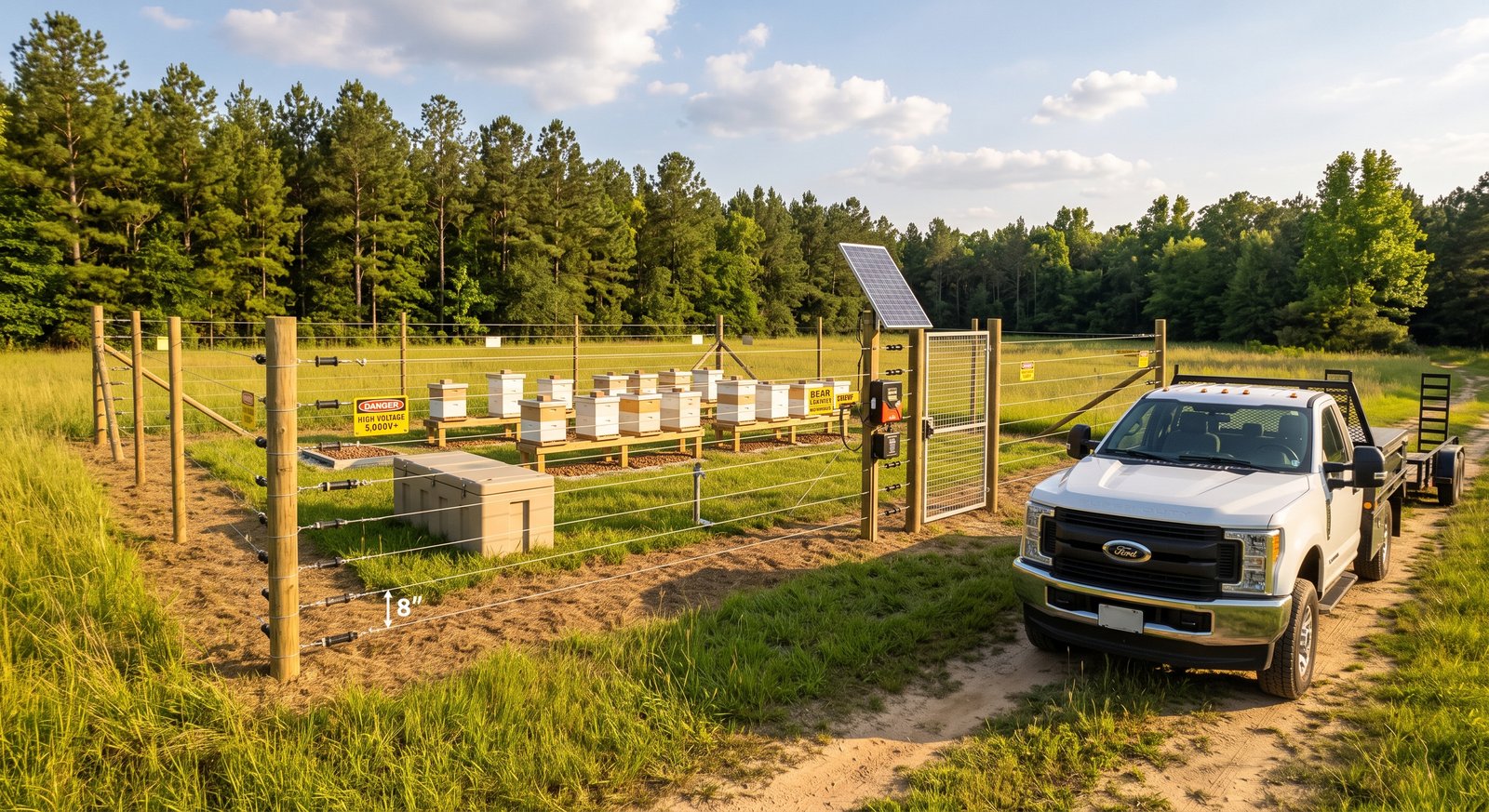
Voltage: Continuous 5,000V to 6,000V under load powered by a 0.5 to 1.0 Joule low-impedance solar or AC energizer.
Configuration: 4 to 5 strands of high-tensile wire. Bottom wire at 6–8 inches (stops skunks and hogs), top wire at 42–48 inches. Alternating ground wires required if soil is excessively dry or sandy.
Ground Clearance: Landowner must weed-eat a 12-inch clear swath beneath the lowest strand to prevent battery drain.
2. Appropriate Sizing (480+ sq ft)
Footprint Ratio: 35 to 45 sq ft of clear enclosed space per hive slot.
Baseline (6 Hives): Absolute minimum of 480 sq ft ($20\text{ ft} \times 24\text{ ft}$) for a 5-acre Walker CAD parcel to house sufficient stands for spring splits and disease isolation.
Expansion: +70 sq ft for each additional statutory CAD hive required for larger parcels.
3. Intra-Enclosure Water Supply
Internal Source: Water must terminate inside the electrified perimeter (or through a hard-plumbed bib inside). Eliminates open hoses running across hot wires or leaving gates propped open.
Proximity: Source terminating within 25 feet of the hive stands.
Anti-Drowning: Water stations must feature floating rafts, clean gravel, or expanded clay pebbles.
4. Intra-Enclosure Dry Storage Box
Weatherproof Container: Heavy-duty resin deck box or job box anchored inside the fence within 20 feet of stands.
Contents: Houses smoker fuel, hive tools, entrance reducers, syrup feeders, and emergency therapies safe from rain, raccoons, and bears.
Estate Frame Freezer: Estate clients must maintain a separate dedicated chest freezer in a barn/garage for 48-hour comb freezing.
5. 24-Hour Truck & Gate Clearance
Unrestricted Dispatch: 24-hour access via combination lock, key, or keypad code. Necessary for nighttime relocations when foragers are home.
Vehicle Specs: Driveways, lanes, and pasture gates must accommodate a 1-ton commercial service vehicle (Ford F-350 / Ram 4500) and trailer.
Staging: Truck must be able to park and turn around within 25 feet of the apiary walk gate.
6. Solar & Wind Orientation
Hive Direction: Entrances oriented South or Southeast to catch early morning sun, warming the cluster for early foraging flights.
Thermal Protection: Positioned with a North treeline or windbreak against cold winter winds.
Canopy & Elevation: High, well-drained soil. Full sun is strongly preferred to suppress Small Hive Beetles.
Optimal Apiary Enclosure Architecture
Recommended spatial layout for a perimeter holding hives with expansion capacity.
Pre-Deployment Landowner Checklist
- Boundary measured to at least 480 sq ft ($20\text{ ft} \times 24\text{ ft}$) on high, well-drained grade.
- Physical perimeter fence erected (field wire, hog panels, or chain link) with 4-foot walk gate.
- Low-impedance electric fence installed with bottom wire at 6–8" and top wire at 42–48".
- Fence tester verifies 5,000V+ continuous pulse under field vegetation load.
- Dedicated hose bib or gravity water source plumbed directly inside the enclosure.
- Weatherproof resin deck box staged inside the yard for equipment and smoker fuel.
- 10-foot wide road/pasture gate with combination lock code provided to Scheel Apiary.
Site Selection Red Flags (Avoid)
- Low Hardwood Bottoms: Damp, foggy bottoms cause damp hive conditions and severe Small Hive Beetle infestation.
- Unfenced Livestock: Cattle and horses will use beehives as rubbing posts, immediately tipping colonies.
- Overhead Branch Hazards: Dead limbs that could fall during high Piney Woods windstorms.
- Unplumbed Water: Requiring operators to drag garden hoses across fences.
- Locked Gates Without Codes: Inability to service hives at dawn or night terminates active agreements.
- Heavy Afternoon Shade: Texas summers require sun; excessive shade cools hives and slows honey production.
Schedule a Professional Site Assessment
Not sure if your parcel meets appraisal district requirements? Raymond Scheel provides on-site parcel reviews ($250, credited toward your lease setup) in Walker and surrounding counties.